Is your toddler room truly working for the children in it?
Is there enough space for movement and exploration?
Are materials accessible and meaningful, or is the room beginning to feel busy and overwhelming?
Do toddlers move deeply between areas, or are they drifting quickly from one thing to another?
Are children absorbed in play, or are you constantly preparing new “activities” that don’t quite hold their attention?
Designing a toddler environment can feel uncertain. You want the space to feel calm, purposeful and developmentally appropriate. But knowing what that actually looks like for 18–36 months is not always obvious.
If you’re ready to move away from constant activity planning and towards an environment that genuinely supports how toddlers learn, this guide will help you do exactly that.
Want all three guides? Get the Environment Bundle for £24.99 and save £4.98.
Get the Toddler Room Environment Guide
Practical guidance for creating purposeful, independence-building environments for toddlers. Delivered straight to your inbox.
Toddlers learn through movement, repetition and exploration. They carry objects, rebuild towers, return to the same materials again and again, and test ideas through action.
To an adult, this can sometimes look repetitive or chaotic. It can be easy to question whether enough is happening, or whether the room needs more structure or stimulation.
Many practitioners find themselves constantly adjusting the space — adding materials, removing them, reorganising areas and wondering whether they should step in or step back.
Without a clear understanding of how the environment supports learning in the toddler years, it can be difficult to feel confident in those decisions.
This guide helps you step back and see the room differently. Not as a place to constantly prepare activities, but as a thoughtfully prepared environment where toddlers can move, explore, repeat and make sense of the world around them.
What you'll find inside
This isn’t a list of activities or a shopping guide. It’s a framework for thinking about your toddler room differently.
How toddlers actually learn
Through movement, repetition, exploration and interaction with the world around them. Not through constant adult-led activities. This section helps you recognise the patterns already happening in your room and feel more confident in trusting them.
Schemas in toddlers (18–36 months)
Trajectory, transporting, connecting, enclosing, positioning, rotation, orientation and transforming. What these patterns of play look like in practice, and why recognising them helps you understand what toddlers are working on.
Key principles for your toddler room
Fewer resources, more intention. Clearly defined areas that support movement, exploration and focus. Calm colour palettes, accessible materials and environments that allow toddlers to move confidently between spaces.
10 area-by-area breakdowns
From movement spaces and role play areas to early maths, creative exploration and investigation. Each of the 10 areas includes EYFS links, schema connections and visual examples so you can see what these environments look like in practice.
The role of the adult
How to observe without interrupting. When to step in and when to step back. This section explores how the adult supports toddlers through presence, boundaries and thoughtful observation.
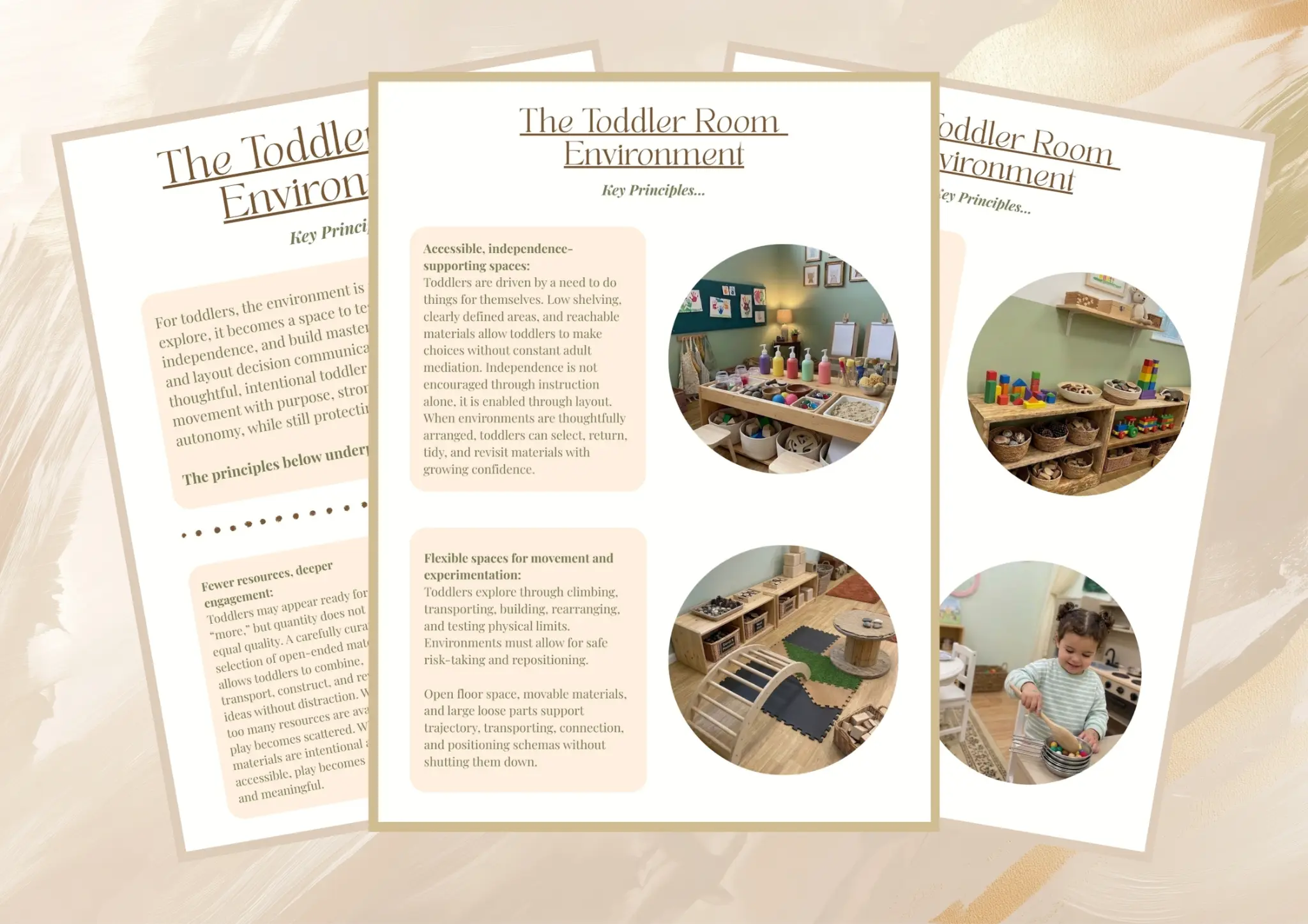
31 pages of practical guidance rooted in child development
Visual examples of toddler room setups
EYFS links for every area to support planning and observations
Schema connections explained in clear, accessible language
Delivered to your inbox within minutes of purchase
Ready to rethink your toddler room?
Get the guide and start creating an environment that supports the way toddlers actually learn.
What changes when you use this guide
When you begin to see how space, layout and materials influence the way toddlers move, explore and interact, your decisions start to feel clearer. You recognise where simplicity strengthens engagement, where well-defined areas support focus, and where small adjustments can make a meaningful difference.
Confidence grows gradually. You feel more assured about when to step back and allow toddlers to repeat actions and revisit ideas, and when to thoughtfully introduce something new. Rather than constantly reorganising the room or adding more resources, you begin refining what is already there.
The environment feels calmer, not because it is minimal, but because it is intentional. Children move more confidently between areas. Materials feel purposeful. The space supports exploration, collaboration and sustained play without overstimulation or unnecessary intervention.
This is what the guide offers: clarity in how you prepare the environment, and confidence in the decisions you make within it.
Get the Toddler Room Environment Guide
£9.99 — delivered straight to your inbox. Practical. Visual. Ready to use today.
Common questions
Do I need to know about schemas before using this guide?
Not at all. The guide introduces schemas in a way that is accessible and grounded in what you will already be seeing in your toddler room. If you find yourself wanting to explore schemas more deeply after reading, the Schema Bundle is a natural next step.
Is this suitable for childminders?
Yes. While the guide is primarily written with nursery practitioners in mind, the principles around environment design, schemas and the adult role apply just as much to childminding settings. You will be able to adapt the ideas to suit your space.
How will I receive the guide?
The guide is a digital PDF. After purchase, it will be sent directly to the email address you provide at checkout. You should receive it within a few minutes. If it doesn't arrive, check your spam or junk folder.
Can I share this with my team?
Absolutely. The guide works well as a shared resource for teams. Whether you use it to support room planning, staff development or team discussions around environment design, it is designed to be practical and easy to refer back to together.